Τruthfully. The life of Charita Mandoles

Τruthfully. The life of Charita Mandoles

PRESENTATION OF THE BOOK “TRUTHFULLY. THE LIFE OF CHARITA MANDOLES”

On April 21, 2016, HARH held a presentation event of the book “Τruthfully. The Life of Charita Mandoles” which was held under the auspices of the Consulate General of the Republic of Cyprus in Thessaloniki. The book was presented by Mr. Petros Papapolyviou, Associate Professor of Contemporary Greek History at the University of Cyprus. The event was attended by the author Mrs. Evridiki Pericleous Papadopoulou, the heroine of the book Mrs. Charita Mandoles and the school teacher Mrs. Eleni Foka who was trapped in occupied Karpassia. The Mixed Choir of the Municipality of Kalamaria contributed artistically to the event, under the direction of Ioannis Koukas.

The book highlights the pain and suffering, the humiliation and degradation spread by the brutality of the occupiers. The idea for its writing was born after the funerals of Charita’s relatives. Through the pages of the book, the catalytic role of the Cypriot woman, every Charita wife, mother and sister, is celebrated, and the strength she can draw from the pain, offering support for the preservation of her family.

Charita Mandoles is one of the most recognizable figures of Cypriot tragedy, as her father Neofytos, her husband Andreas, her sisters’ husbands Phoebus and Theodoros, her uncle Savvas Tsakkas and her cousin Panagiotis were murdered in a mass execution of civilians in which her entire family was present on 21 July 1974. In total, twelve men were executed by the Turkish army, including little Yannakis Kozakos. All of them were on the list of missing persons for 34 years until the moment when scientific DNA research identified their remains and they were handed over to their relatives for burial.

The reader who reads this book will learn about how the women of the missing persons raised their children in the refugee camp and the enormous problems they had to face. About the tragic burden they were asked to carry and are carrying for their children, who grew up with a photograph in their hands and with thousands of huge unanswered questions. At the same time, he will admire the mental toughness of Charita Mandoles, a fighter and stubborn woman from her childhood, who, in spite of the times and many other difficulties, did not cease to claim and fight.

According to Professor Papapolyviou of the University of Cyprus, the book is “one of the best books ever written on the events of the 1974 Turkish invasion and their consequences. For those who seek standards of struggle, but also a crack of hope and optimism in the gloomy and suffocating phenomena of the decline of public life”.

Kalamaria as we experienced it

Kalamaria as we experienced it

By Stamatis Pararas

Presentation of the book, November 18, 2015.

The author describes customs and events of refugee life before and after the war, as well as the characters of people in a descriptive, but also humorous or poignant way. He describes everyday events of a bygone era, the ones that remain vivid in memory, that younger people heard from their fathers and grandfathers and that older people experienced.

….Somewhere at the end of Pontou Street lived an old lady with a raisin face, well known in Kalamaria, because she lifted the evil eye with beans, predicted the future with cards, communicated with the beyond and interpreted dreams.

A similar case was that of a lady who communicated with the icons of the Saints in the settlement of Derkon.

There was another in Byzantium who got hypnotized in order to predict the future.

Another one in the center of Kalamaria who was curing the “sarliki” (children’s golden disease).

Another case of “Solomonic” that is worth mentioning, because it concerned women who wanted to know what would happen to them in the future, was “the summoning of spirits”.

The Street vendors roamed everywhere and proclaimed their goods to meet the nutritional and other living needs of the inhabitants, such as:

  • Fishermen with round tablets on their heads,
  • Milkmen with metal pitchers in their hands,
  • Yoghurt makers with their specially invented improvised construction, carrying, distributing and selling yoghurt,
  • Knife sharpeners with their huge foot-powered sharpening machines,
  • Tinsmiths or tinplaters,
  • Ice-sellers in summer,
  • Quilts with shakes on the back,
  • Chair makers with mats and wires,
  • Koundourades (shoe repairmen).

The book presents images of that era and references to the times and places where we played and grew up. They are the vivid impressions of a difficult time that memory recreates and preserves.


Ananias Tsirambides, Professor Emeritus of the Aristotle University of Thessaloniki, Member of the Board of HARH

The square (today Metamorfoseos Street) behind the sanctuary of the Metropolitan Church of the same name. Early 1950s.

  1. 3rd class of Kalamaria Primary School with teacher Panagiotis Kazantzidis.

1928, The actors Fotopoulos, Diannelos etc. attend a theatrical performance at the Kalamaria theatre, organized by the unforgettable director Nikos Argyropoulos.

1928, First inmates of the “Asylum of Bum Child”. On the left the first director Antonis Pararas (father of the author), on the right the first administrator A. Apostolidis.

The code of modern Turkey – The engineering of the ethnicities of “Union and Progress” 1913-1918

The code of modern Turkey – The engineering of the ethnicities of “Union and Progress” 1913-1918

PRESENTATION OF THE BOOK ‘THE CODE OF MODERN TURKEY – THE ENGINEERING OF THE ETHNICITIES OF “UNION AND PROGRESS” 1913-1918’


On May 27, 2015, the Historical Archive of Refugee Hellenism of the Municipality of Kalamaria and the New Circle of Constantinopolitans presented the book of Fuat Dündar, με τίτλο: The code of modern Turkey – The engineering of the ethnicities of “Union and Progress” 1913-1918.

The following spoke about the book:

Nikolaos Uzounoglou, Professor of National Technical University of Athens – President of the New Circle of Constantinopolitans.

Ioannis K. Hasiotis, Professor Emeritus of Modern History of the Aristotle University of Thessaloniki.

Iakovos Michailidis, Associate Professor of Modern and Contemporary History, Aristotle University of Thessaloniki.

Haris Tsirkinidis, Writer – Historian.

Mr. Iakovos Michailidis referred to the dialogue that is taking place in Turkey on this issue and the author and historian Haris Tsirkinidis to his own research on the subject. They all praised the contribution, with concrete evidence, of Fuat Dündar to this huge crime, from the guilt of which Turkey will not be absolved unless it acknowledges it.

This work, based on the reports, documents, research and data of the Union and Progress and the secret, unclassified encrypted war telegrams of the Ottoman state, analyzes the policies of the ‘resettlement’ operations of populations. It describes the displacements, exchanges and relocations of Ottoman Greeks, Armenians, Kurds, Jews, Bulgarians, Nestorians and Assyrians, as well as the ideological reasons for these “resettlements”, how they were formulated and by whom they were implemented. This policy, which was the cornerstone of the nationalist program of the Union and Progress, the racial concepts on which it was based and the accomplished population events to which it led, unfortunately constituted the most damaging and toxic legacy of the Ottoman Empire to the subsequent Turkish state.

From left: S. Georgiadis (President of HARH), I. Hasiotis, Professor Emeritus, I. Michailidis, N. Uzounoglou, V. Tsirkinidis (photo: Vassilis Sakellaridis)

Kalamaria as we experienced it

2015

Kalamaria as we experienced it

Author

Stamatis Pararas

Editing

Ananias Tsirambides - Maria Kazantzidou

Publisher

Despina Kyriakidi

ISBN

978-960-599-001-5

Year of publishing

2015

Pages:

125

Price

8,00 €

The book records the image of post-war Kalamaria through the description of everyday events, characteristic persons, neighborhoods and customs. The rich photographic material, selected from private collections or magazines of the time, aims to keep alive the memory of everyday life and solidarity of the residents of Kalamaria.

The classification of the material into small chapters makes it easier for the reader to directly understand the temperament of the characters of the era described. Without literary enclosures and personal positions, but with descriptiveness and simple wording, the author facilitates the reader’s approach to the text.

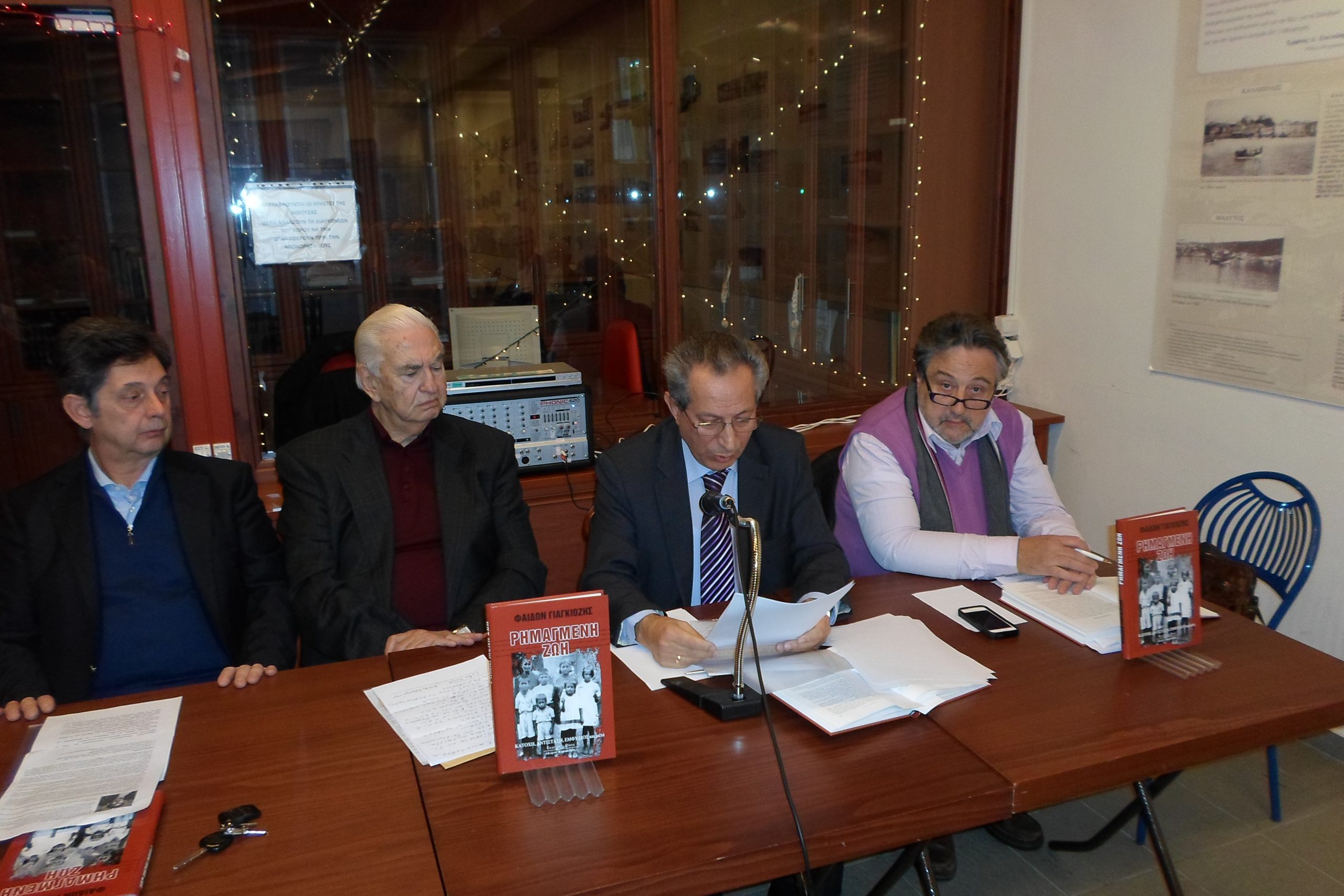
Ruined life: Occupation, resistance, civil war and thereafter

Ruined life: Occupation, resistance, civil war and thereafter

By Phaedon Yagiozis, journalist

Presentation of the book, December 13, 2013

The work of our dear friend Phaedon presents briefly, but in a very vivid and critical way, historical aspects of the occupation, the resistance, the civil war and the years afterwards, most of the time without taking a position in favor of one side or the other. After all, very little time has passed since these shocking events and the memories are still fresh. The reported oral testimonies of various events cannot be disputed. Thus, the reader can draw his own conclusions, even from the details that are recorded.

The German occupation caused many deaths from starvation, cold, but also from diseases, especially tuberculosis. There were two categories of resistance groups: the EAM-EPON-ELAS on the one hand and the EDES-PAO-EKKES on the other.

Apart from the geostrategic interest, the Germans also had an economic interest in Thessaloniki. Recognized-Registered-Secured-Confiscated-Transferred, terminology used by the Wehrmacht for products such as oil, textiles, tobacco, cotton, leather and minerals of all kinds. 11 of the 15 requisitioned active mines in Macedonia supplied minerals mainly to the KRUPP military industry. In the fall of 1942, there was a shortage of personnel in these mines because Greeks refused to work because of the very low pay. Typical is the intervention of the Wehrmacht Economic Office for the mines of Vavdos in Chalkidiki (producing magnesite), where wages were increased fivefold. During the occupation, three lignite-fired power plants were operating in Thessaloniki. In the winter of 1941-42 more than 120,000 Thessalonians were fed by offered meals. They were 50% of the city’s population.

In chapter 16, Phaedon presents facts on the subject of Macedonia. Tito’s partisans are coveting Macedonia led by General Vukmanovich. With the acquiescence of the Greek Communist Party (GCP), a Balkan Command was created, on the condition of equal participation of Greeks and Serbs, but this was not subsequently respected. At the end of 1943 the GCP consented to the creation of the Slavo-Macedonian People’s Liberation Front (SNOF). In the same period, the Bulgarians created their own organization, EMEO. Before 1943, there is no historical source for the existence of a Slavo-Macedonian ethnicity. GCP changed its position after 1974: there is no Slavic minority in Greece. There are bilinguals with Greek national consciousness. The sermons of the 1903 Ilinden Revolution form the ideological basis of the current EMEO-DKMEE party in FYROM (now North Macedonia). One of the fighters of this revolution was Gotse Delchev, of Bulgarian origin. He was born in Kilkis in 1872 and was killed in a battle with the Turks in Banitsa (region of Oreini) of Serres in 1903. Today he is a common national hero in northern Macedonia and Bulgaria, where towns are named after him (Delchevo and Gotse Delchev, respectively). At the end of chapter 16 Phaedon notes: “We must not forget that the route to the Aegean is the dream of all South Slavs and Bulgarians, not only of the Slavo-Macedonians”.

The book consists of 257 pages and its content is divided into 25 chapters. 85 pages of selected photographs accompanied by very informative explanations follow.


Ananias Tsirambides, Professor Emeritus of the Aristotle University of Thessaloniki, Member of the Board of HARH

Nikolaos Votsis and the torpedoing of Fethi Bulent

Nikolaos Votsis and the torpedoing of Fethi Bulent

By Argyris Maltsidis, former Municipal Councilor of Thessaloniki

Presentation of the book, March 10, 2013

Argyris Maltsidis expresses his question whether it was a coincidence that Votsis visited Thessaloniki about five months before his death in Paris (Sept. 1931) from a serious illness. Both the author himself, and all of us, appreciate that his great achievement linked him firmly to Thessaloniki. Perhaps he worshiped it as his second birthplace.

In 1934, the then called settlement Stylianos Gonatas, east of Thessaloniki, was given the name “Votsis” in honor of the glorious Vice Admiral Nikolaos Votsis who managed to sink the Turkish flagship Fethi Bulent (Glorious Conquest) in the port of Thessaloniki during the struggle for the liberation of Macedonia in October 1912.

To this naval hero is mentioned the book of my dear friend Argyris Maltsidis which contains very important information about the recent history of Thessaloniki. That is why it should not be missing from any home of a Thessalonikian.

The book is very stylish, leather bound and has 102 pages. The 21 chapters and the appendix include:

  • 48 photographs and 10 newspaper articles.
  • A nautical map of the entry-exit route of the torpedo boat 11 in the Thermaikos Gulf on the night of 18 October 1912.
  • A list of the 25 men of the crew and the two navigators.
  • The Admiral’s marble monuments in Thessaloniki (White Tower), in the Maritime Museum of Litochoro, in his birthplace Hydra and in his family grave in the 1st Cemetery of Athens.
  • Details of his resignation as High Commissioner of Greece in Constantinople.
  • Valuable information about the Turkish fortress of Megalo Karambournou.
  • At the book’s epigraph the lyrics of a thieving song about Admiral Votsis and a photograph of the album with its contributors, are presented.
  • The author uses 10 bibliographic references, as well as other sources such as newspapers, archives and the internet.

Mr. Bakoglidis, dear Mayor of Kalamaria, the residents of the settlement are eager to see the park with the Votsis monument that you promised two years ago. We, too, with our schoolchildren, wish to honor him every year. Do not delay the project any longer. Today when heroes/standards are lacking in our country, Admiral Votsis offers himself as an ideal example of such a man. But are we ready to fight, to dare, not to be disappointed?

Thank you.


Ananias Tsirambides, Professor Emeritus of the Aristotle University of Thessaloniki, Member of the Board of HARH

In the Homeland it was different. Memories of the East 1870-1924

In the Homeland it was different. Memories of the East 1870-1924

In the Homeland it was different

By Georgios Manos, Agronomist, retired banker

Presentation of the book, March 1, 2013

Those who lived close to the refugees know very well that these homeless, ragged, starving and barefoot people did not just stand up. With their faith, their strength of soul, their culture and their hard work, they fought, progressed and distinguished themselves. They fought the forces of nature and poverty and won. In all battles they came out victorious. Only one thing they could not win. The nostalgia for “the Homeland”, which ate their insides like a woodworm. Their only consolation was memory. Most of their conversations, in the field or at night, were centered on the Homeland. They wanted to tell and re-tell it, thinking they were turning back the clock, reliving it. Slowly, however, the refugees of the first generation began to leave one by one. But they didn’t leave alone. They took with them into oblivion, their history, their language, their culture.

The sense of the great void they felt when they left prompted me to document their lives “at home”. I started from the sounds I had as a child. Then with a tape recorder I collected live testimonies. I also searched newspapers, magazines and historical aids. From the material I gathered, two books emerged, two different refugee stories. The title of the first one, “LEAP TIMES AND FURIOUS MONTHS “, is taken from the song of the Dead Brother, while the title of the second one, “IN THE HOMELAND IT WAS DIFFERENT. MEMORIES OF THE EAST 1870-1924”, is the last sentence of all the refugee narratives: “In the homeland everything was different”.

Both books are written in the idiomatic language spoken by the Greeks of the East and especially in the environs of Constantinople, with all the pauses, sounds and rhythm of the orality of that period. I preferred consciously to choose this language, because language, apart from being a means of communication and expression, is also an element of a people’s culture and identity.

The books are not historical in the formal sense. The historical events to which they refer arise through the narration of the protagonists themselves, as their own experiential elements. They live them, they tell them, and we learn them too. But they are not novels either, because they are based on real events and real people. That is why I have called them historical narratives.

My characters don’t just talk about historical events. They also talk about their lives and their everyday life. They are born, grow up, work, fall in love, marry, celebrate, sing, dance, and grieve. Through their narratives we learn about their language, their customs, their songs and dances, their clothing, their festivals, their weddings (joys), their christenings, their nights, their daily activities, the relations between them but also with the Turks, we learn about the self-government of the communities, about the very important role of the church and especially of the village priest, we learn about Constantinople, Smyrna and other cities, and about the legends of the time (Agia-Sofia, etc.).

Finally, through the pages of the books, it emerges that the annihilation of the Greeks of the Ottoman Empire was not a random event, but the result of a well thought out Turkish plan, which, with the slogan “Turkey to the Turks”, aimed at the disappearance of Christians in every way, and the creation of a pure Turkish state. Its implementation began in the spring of 1914 in Eastern Thrace and then extended to Asia Minor and Pontus.

From left:

– Angeliki Tsapakidou, Assistant Professor at the University of Western Macedonia and member of the HARH Board, moderator of the event

– Georgios Manos, author of the two books.

– Sophia Temekenidou, philologist and member of the Board of HARH.

– Maria Kazantzidou, HARH historian.

– Stylianos Manologlou, lawyer.

– Epaminontas Fachantidis, Professor Emeritus of the Aristotle University of Thessaloniki and President of the Association of Pontic Clubs of Thessaloniki.

Thessaloniki capital of the refugees. Refugees in the city from 1912 until today. Conference Proceedings

2013

Thessaloniki capital of the refugees. Refugees in the city from 1912 until today. Conference Proceedings

Author

Collective work

Editing

Ananias Tsirambides - Maria Kazantzidou - Irini Tellidou

Publisher

Kyriakidis Bros

ISBN

978-960-467-466-4

Year of publishing

2013

Pages:

575

Price

25,00 €

Proceedings of a conference organized by the Historical Archive of Refugee Hellenism of the Municipality of Kalamaria from 23 to 25 November 2012 on the occasion of the 100th Anniversary of the Liberation of Thessaloniki. The volume includes 42 works by scientists from universities, research centers and associations in Greece and abroad. The speakers were of various disciplines such as historians, social anthropologists, political scientists, economists, lawyers, architects, urban planners, philologists, folklorists, etc. The announcements offered to everyone interested important information about Thessaloniki of the last 100 years and concerned the following sections:

  • World War I. Refugees in the 1910s.
  • The role of the press.
  • Refugees of the interwar period. Settlement – Rehabilitation.
  • Refugees of the interwar period. Charity – Social integration.
  • Residential structure – Architecture.
  • Identity Setting – Memory Management.
  • Literature.

Thessaloniki, capital of refugees. Refugees in the city from 1912 until today

Thessaloniki, capital of refugees. Refugees in the city from 1912 until today

Thessaloniki, capital of refugees“. Refugees in the city from 1912 until today.


1st Scientific Conference

During the 20th century Thessaloniki, due to its geographical location and other parameters, received hundreds of thousands of refugees, mainly of Greek origin and consciousness. In 2012, Thessaloniki celebrated and commemorated the 100th anniversary of its Liberation and at the same time evaluated its course during a whole century. The refugee populations from Asia Minor, the Balkans and the countries of the former Soviet Union are one of the main components of its identity as a city of the Greek state.

In the context of the celebration of the anniversary of the Liberation of Thessaloniki (1912-2012), the Municipality of Kalamaria and the Historical Archive of Refugee Hellenism of the Municipality of Kalamaria – organized a conference on the topic: Thessaloniki, capital of refugees“. Refugees in the city from 1912 until today.

The conference took place on the three days 23, 24, 25 November 2012 at the Municipal Theatre of Kalamaria “Melina Merkouri”. 57 scientists from universities and research centers in Greece and abroad (UK, France, Belgium, USA, Turkey, Serbia, USA), of various disciplines such as historians, social anthropologists, political scientists, philologists, folklorists, architects, urban planners, economists, lawyers, etc. participated.

The documentary “Twice a Stranger”, a co-production of NET and ANEMON Productions, was screened during the parallel events. An exhibition of photographs and topographical maps on the settlement of refugees in Thessaloniki in the period 1920-1930 was also held.

The conference was a top cultural and educational anniversary event for Metropolitan Thessaloniki.

Music and dance event of the Progressive Association of Aretsou-Derkon

Music and dance event of the Progressive Association of Aretsou-Derkon

On June 16, 2011, at the cultural hall “Propontis” a music and dance event was held with the band Rebetalika.